Note Purpose-driven CRM starts with a question your team cannot answer
Oct 05, 2026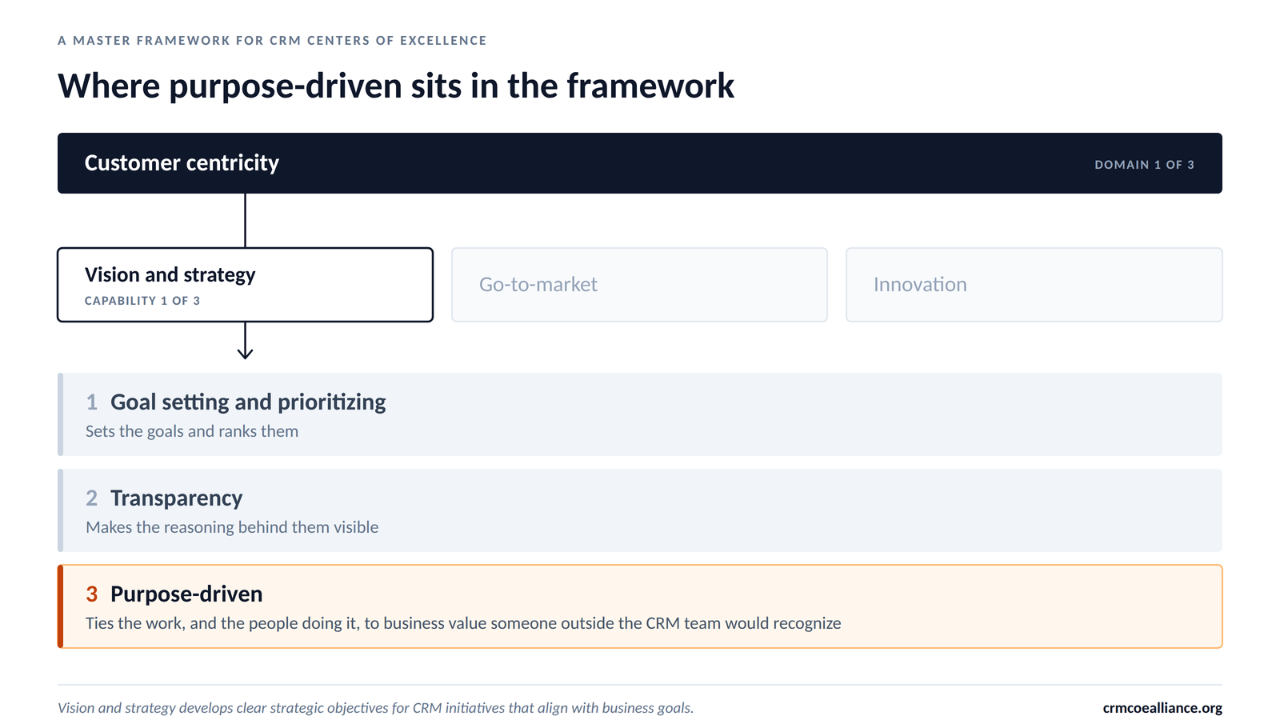
Ask five people in your CRM organization which business number their last release moved. The spread in those answers is your real governance score.
Thirty-one percent of chief sales officers named difficulty proving the ROI of AI-driven tools as a top challenge for their 2026 objectives (Gartner, 2026). You can read that as a measurement problem and go buy another dashboard. Read it properly and it is something harder. These are the executives sitting closest to the revenue. A third of them cannot connect the tools their teams touch every day to a number they would defend in front of a board. The tooling is not the gap. The chain between the work and the value was never built, and nothing in the standard way we run CRM programs requires anyone to build it.
The problem nobody owns
Every CRM program has an owner for delivery. Someone owns the backlog. Someone owns the release. Someone owns the adoption report.
Almost nobody owns the question of whether the work produced value a business leader would recognize.
That is not negligence, and it is not a competence problem at your company. It is structural. Delivery accountability is written into every project methodology in use. Value accountability sits outside all of them. So it lands on whoever happens to care, usually the CoE lead, usually unpaid and unmandated. When that person changes roles, it stops happening, and nobody notices for two quarters.
The same gap shows up well outside CRM. Gartner found 67% of supply chain digital investment flowing to AI while 55% of chief supply chain officers could not clearly track the ROI of that spend (Gartner, 2026). Different function, identical shape. Money moves faster than the ability to account for it.
So when your CRM program cannot name its value, you are not looking at a weak team. You are looking at a profession that never standardized the one function that would have caught it.
Where purpose-driven fits
Customer centricity is the first domain in the framework. Vision and strategy is its first capability, and its job is to develop clear strategic objectives for CRM initiatives that align with business goals. Three functions carry that capability, in order.
Goal setting and prioritizing sets the goals and ranks them. Transparency makes the reasoning behind them visible. Purpose-driven is the third, and it closes the capability by doing the part most programs skip entirely: it ties the work, and the people doing the work, to business value somebody outside the CRM team would recognize.
The standard we wrote into the book is deliberately set at the individual, not at the program. Every person in the CRM ecosystem can name a past, a current and a future business improvement their work delivered. Every person can name the core customer their CRM serves, and one idea for serving them better.
Read that level again. Not the CoE lead. Not the steering committee deck. Every person, including the admin who closed six tickets this morning.
That is a high bar, and it is high on purpose. A program where only the leader can explain the value has one point of failure and no defense. When the budget review comes, the work that cannot be tied to a driver goes first, and nobody in the room is equipped to argue for it. Including you, because you are arguing from a roadmap rather than from a result.
What good looks like
Purpose-driven is working when these are all true, and testable in an afternoon:
- Every roadmap item carries a named business driver and a named person accountable for it. Not a theme. A driver someone in finance would recognize.
- Every member of the CRM team can state, without preparation, the core customer they serve and the business number their current work moves.
- Value gets reviewed on the same cadence as delivery. If you review delivery weekly and value annually, you have already decided which one matters.
- The program publishes realized value, not forecast value. Forecasts are a pitch. Realized value is a record.
- Somebody owns the function by name, and it appears in their objectives.
Here is the five-second test. Walk into your next sprint review and ask for the business driver behind the top item. A healthy program answers immediately. An unhealthy one offers to set up a follow-up meeting, which is the answer.
The evidence
The hard number is the one above: a third of chief sales officers cannot prove the ROI of the AI tools already in their stack (Gartner, 2026). That figure is about AI, but the mechanism is older than AI. New capability arrives, gets deployed, and the accounting never catches up.
The pattern evidence is consistent across the programs I have watched fail at this over 25 years, and the tell is always the same. The roadmap is full. The team is busy. Reporting is clean. And when you ask an admin which corporate driver their last release moved, you get a pause and then a description of the feature.
The structural logic is short enough to test against your own organization. No owner for value articulation, so the connection is never written down. Nothing written down, so it lives in one person's head. That person leaves, and the program's entire value story leaves with them. Two quarters later the board reads a disappointing number and concludes it bought the wrong technology.
Why a universal standard, not your own framework
Your organization can define purpose-driven however it likes. Five hundred organizations doing exactly that is what the industry has now, and it costs all of them.
A CRM leader who built real value discipline at one company cannot carry the evidence anywhere, because the next employer measures something else. Talent stops being portable, so experience stops compounding.
No board can compare its CRM program to a peer, because there is no shared definition of what value articulation even looks like. Every CRM investment case gets argued from scratch, in-house, against no benchmark.
Vendors and partners claim CoE expertise freely, and the claim is unfalsifiable. Nothing to measure it against means nothing to disprove it with.
And the profession cannot certify its own people. You cannot credential a skill the industry has not agreed on. That is the part that should bother anyone who has spent a career doing this work and watched it be treated as an implementation role.
One standard definition of this function, used across organizations, fixes all four at once. Not because the definition is clever, but because it is shared.
What this means for you
If you lead a CRM organization
Your exposure is not the roadmap, it is the day the roadmap gets questioned. Run the five-person test this week and treat the spread in answers as a number you own. It costs nothing and it tells you whether you can defend the program without being in the room.
If you build and run the CoE
This is the function that makes your work legible to people who approve budgets. Take the top item in your current sprint, write the person it serves and the business number it moves, one line each. If the second line is hard, that is the item telling you something.
If you deliver CRM for clients
Delivery and value come apart easily. You can hit every milestone and still leave behind a team that calls your work "the implementation" rather than "the thing that halved our quote cycle." Build this function into the engagement and your best reference becomes a client who can explain the value without you there.
Where to start
Pick one in-flight initiative. Write down the core customer it serves, the business driver it moves, and the person accountable for that driver. Then ask the people doing the work to do the same thing independently, and compare. The gap between your answer and theirs is the work.
If you want the full function set and the standards behind them, the framework is laid out in A Master Framework for CRM Centers of Excellence.
A busy CRM team and a valuable one are not the same thing, and only one of them survives a budget cut.
Stay connected with news and updates!
Join our mailing list to receive the latest news and updates from our team.
Don't worry, your information will not be shared.
We hate SPAM. We will never sell your information, for any reason.